
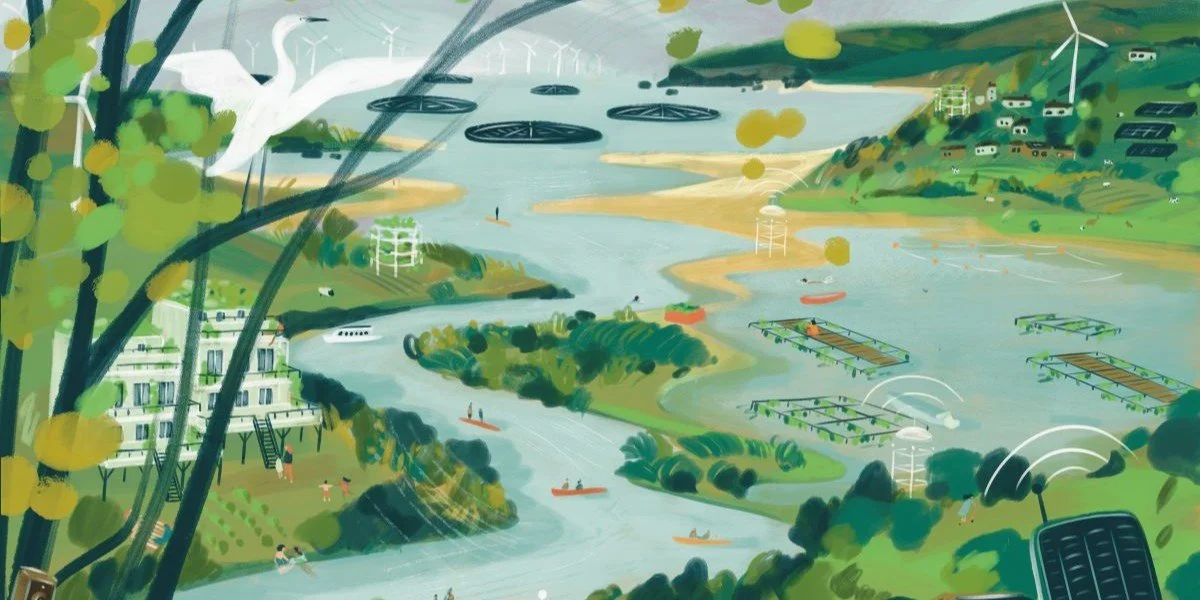
Imagining futures from the places we inhabit.
It is often easier to describe the environmental future we fear than the one we might actually want to inhabit. Climate projections, biodiversity decline and the pressures on land and water provide plenty of reasons for concern. But what happens when people are invited to imagine what a good future for their own landscape might look like?
The Good Anthropocene project, a collaboration between WWF and researchers at the University of York, explored this question through workshops in Pembrokeshire, Norfolk and the Firth of Forth. Participants developed stories about their future landscapes, which were then interpreted through a series of original artworks.
The visions were not simply technological utopias. They brought together renewable energy, restored marine habitats and climate-adapted buildings with sea allotments, traditional practices, local languages and seasonal celebrations.
I find the combination particularly interesting. It suggests that imagining environmental futures need not mean choosing between innovation and tradition, or between human activity and ecological recovery. But these are imaginative possibilities, not predictions or agreed community plans. Their value may lie in opening conversations about what people want to protect, change and create together — and what needs to happen now to make those possibilities more likely.
Source: WWF-UK and the Leverhulme Centre for Anthropocene Biodiversity, University of York. Published October 2026.
Read the report | Explore the project