
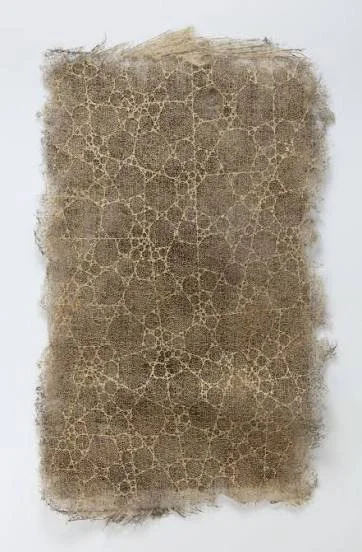
German-born artist Diana Scherer, based in Amsterdam, has spent several years exploring this possibility through her project Interwoven. Working with plants such as wheat and oats, she has developed a technique that guides their roots into intricate, textile-like structures. By placing specially designed templates beneath the soil, she influences the routes roots can take as they grow in search of water and nutrients. The result, once harvested, is a remarkable network of living fibres resembling lace, embroidery and woven fabric.
What interests me about Scherer's work is the relationship between intention and autonomy. She establishes the conditions and directs the process, but the plants retain a degree of unpredictability. The finished work is neither entirely human-made nor entirely independent of human intervention. It emerges somewhere between the two.
There is an interesting parallel here with traditional crafts and ecological knowledge. Much of human making has historically involved working with the characteristics of particular materials rather than simply imposing a design upon them. Basket makers understand the properties of willow, woodworkers work with grain, and textile makers learn how fibres behave. Skill involves understanding what a material can do, as well as what we want it to do.
Scherer's work takes this relationship a step further. The material is not merely harvested and shaped; its formation is part of the creative process itself.
There are obvious questions about the potential for grown materials to contribute to more sustainable manufacturing, although these artworks are not yet practical replacements for conventional textiles. But perhaps their immediate value is less about providing an alternative fabric and more about challenging our assumptions about making, control and collaboration.
We tend to think of creativity as something humans do to the world around them. Scherer's work invites us to consider what happens when we create the conditions for other living processes to participate.
Perhaps the distinction between making something and growing something is not quite as clear as we imagine.
Source: Diana Scherer – Interwoven: Exercises in Root System Domestication – the artist's own work and project documentation.
Further Reading: Interview with Diana Scherer: Weaving roots at the interface between art, fashion and science – Plants, People, Planet, 2019. Particularly useful for understanding the development of the technique and her collaboration with plant scientists at Radboud University.